In this guide (16 sections)
- The big picture: how the pieces fit together
- Step 1: Choose who you're helping
- Step 2: Join an affiliate program
- Step 3: Pick one main offer
- Step 4: Create a landing page
- Step 5: Write a short email series
- Step 6: Choose one traffic source
- Step 7: Track everything
- Step 8: Improve weekly
- Your first 30 days
- Choosing a niche: a quick scoring method
- Evaluating an affiliate offer like a pro
- Email templates you can adapt
- Reading your numbers: an example
- Scaling up: what to do after month one
- Beginner mistakes that slow everything down
Affiliate marketing has a lot of moving parts, so it's easy to get stuck reading instead of doing. This is the order that makes sense for most beginners: eight steps, each with what to do, what "done" looks like and the common mistakes to avoid.
The big picture: how the pieces fit together
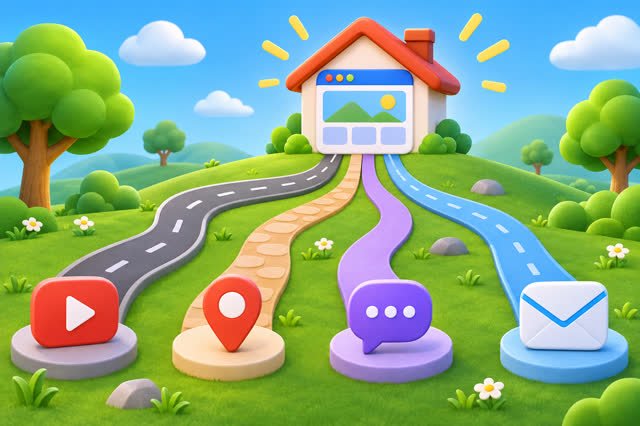
Every affiliate business, whether it runs on YouTube, TikTok, a blog or ads, has the same four parts:
- Traffic: people who see your content or ads.
- Capture: a page where interested people join your email list.
- Follow-up: emails that build trust and make recommendations.
- Offer: the product you recommend with your affiliate link.
The eight steps below build those parts in order. Don't skip ahead to traffic before the capture and follow-up are ready, or you'll waste your first visitors.
Step 1: Choose who you're helping
Write one sentence: "I help [who] with [problem]." For example: "I help new freelancers find their first clients," or "I help busy parents cook healthy meals on a budget." That sentence decides your offers, your content and where you look for traffic.
Done when: you can list 30 questions this audience asks.
Mistake to avoid: picking "make money online" as your niche because it pays well. It's crowded, and audiences there are hard to win without a clear angle.

Step 2: Join an affiliate program
Look for programs that sell what your audience needs:
| Network | What it's good for |
|---|---|
| ClickBank, Digistore24 | Digital products and courses, easy approval |
| Amazon Associates | Physical products in almost any niche (low commission %) |
| Impact, ShareASale, CJ | Well-known brands across many categories |
| Software in-house programs | Tools your audience uses, often recurring commissions |
Done when: you're approved for at least one program and have your link.
Step 3: Pick one main offer
Choose one product to focus on first. Check the sales page as a buyer would, the refund policy, the commission and cookie length, and whether the company has real support. One focused offer is easier to talk about than ten.
Done when: you can explain in two sentences who the product is for and why it helps.
Step 4: Create a landing page
Instead of sending visitors straight to the seller, send them to your own page that offers something free, such as a checklist, template, short video series or mini-course. Collecting the email lets you follow up, which matters because most people don't buy on their first visit.
Keep it simple: a clear headline, 3 bullet points, an email box and one button. A plain page that loads fast on a phone beats a fancy one.
Done when: you've signed up yourself and received the freebie.
Step 5: Write a short email series
Three to seven emails over the first week is enough to start:
- Day 0: welcome, deliver the freebie, say what to expect.
- Day 1: one quick, useful tip.
- Day 2: a short honest story about a problem you faced.
- Day 3: your recommendation, why it helps, with a disclosure.
- Day 4: answer common questions and objections.
- Day 6: a mistake to avoid, with a softer reminder of the recommendation.
After the series, keep emailing 2–4 times a week with tips and occasional recommendations. More in free email list building.
Done when: the series is loaded into your email tool and sends automatically.
Step 6: Choose one traffic source
Free options: short videos, Pinterest, groups and forums, YouTube. Paid options: solo ads, push or native ads, social ads. Beginners do best with one free channel first, because it teaches you what your audience responds to without risking money.
See free traffic for affiliate links for nine sources and how to use each without getting banned.
Done when: you've published daily for two weeks.
Step 7: Track everything
Tag every link with where it was posted. Then read your numbers like a diagnosis:
| If this is low… | Fix this |
|---|---|
| Visitors | Post more often, try different hooks or topics, or a different channel |
| Opt-in rate | Headline, lead magnet or page speed on mobile |
| Email opens | Subject lines, sending frequency, list quality |
| Email clicks | Email content and how clearly you explain the benefit |
| Sales | Offer fit, trust-building emails, or the product itself |
Step 8: Improve weekly
Once a week, look at your numbers and change one thing, such as a headline, the freebie, an email subject line or where you post. Changing one thing at a time tells you what actually worked. Small improvements compound over months.
Your first 30 days
| Week | Focus | Goal |
|---|---|---|
| 1 | Steps 1–5: niche, program, offer, page, emails | Funnel ready and tested |
| 2 | Post daily on one channel | First visitors and sign-ups |
| 3 | Keep posting, answer questions in communities | 20–50 sign-ups |
| 4 | Review numbers, fix the weakest step | A clear next experiment |
These are targets to aim for, not promises. Some niches move faster, some slower.
Choosing a niche: a quick scoring method
If you're torn between niches, score each from 1 to 5 on these questions and add them up:
| Question | Why it matters |
|---|---|
| Could I talk about this for a year? | Consistency is the main driver of free traffic. |
| Do people spend money to solve this problem? | No spending means no commissions. |
| Are there affiliate programs with fair terms? | You need something to recommend. |
| Can I find the audience easily (groups, hashtags, searches)? | Easier first visitors. |
| Do I have some experience or a unique angle? | Helps you stand out from generic content. |
The highest total usually wins. If two are close, pick the one you'd enjoy more; enjoyment keeps you consistent.
Evaluating an affiliate offer like a pro
Before promoting anything, run through this checklist:
- Sales page: is it honest, or does it make claims you'd be embarrassed to repeat?
- Price and fit: can your audience afford it, and does it solve their actual problem?
- Commission: amount or percentage, one-time or recurring, any refund clawbacks.
- Cookie length: how long after a click a purchase still counts for you.
- Payout terms: minimum threshold, payment method, schedule.
- Restrictions: traffic types that are banned (email, paid search, certain countries).
- Support: is there an affiliate manager, and does the vendor answer customer questions?
- Reputation: search the product name plus "reviews" and "refund".
Email templates you can adapt
Welcome email (day 0)
Subject: Here's your [freebie]
Hi [name], thanks for grabbing [freebie], and here's the link: [link]. Quick intro: I [one line about you and your topic]. Over the next few days I'll send you a few short emails with [what they'll learn]. If you have a question, just hit reply. I read every one.
Recommendation email (day 3)
Subject: The tool I use for [task]
Hi [name], a few people asked what I use for [task]. It's [product]. What I like: [2–3 honest points]. What I don't: [1 honest drawback]. It's a good fit if [who it's for]; skip it if [who it's not for]. Here's my link: [link]. (I earn a commission if you buy through it, at no extra cost to you.)
Reading your numbers: an example
Imagine (illustrative numbers) that in a month your page gets 600 visitors and 90 sign-ups. That's a 15% opt-in rate. Your welcome emails get opened by about half of new subscribers, but only a few click your recommendation.
The diagnosis: traffic and the page are working; the weak step is the recommendation email. So next month you'd test a different angle, such as a walkthrough of how you use the product or a comparison with an alternative, rather than changing your traffic or page.
Always fix the weakest step first. It's usually where a small change makes the biggest difference.
Scaling up: what to do after month one
- Double down on the content type and channel that bring engaged subscribers.
- Add a second channel only when the first runs as a habit.
- Extend your email sequence to 10–15 emails covering more questions and a second offer.
- Repurpose: turn a good video into a pin, a carousel and an email.
- Consider small paid tests once your page and emails are proven, with strict tracking.
Beginner mistakes that slow everything down
- Switching niches or offers every week.
- Sending traffic straight to the product with no email capture.
- Promoting products you haven't looked at closely.
- Copying hype-heavy messaging that platforms and readers distrust.
- Spending on ads before the page and emails are proven with free traffic.
If you want the page, follow-up emails and tracking handled for you, there are free platforms that do it, including the Affsense Profits Club. Either way, the steps are the same. For the no-budget version of this plan, read how to start affiliate marketing with no money.
Frequently asked questions
What is the first step in affiliate marketing?
Choose a specific audience you want to help. Everything else (offers, content and traffic) gets easier once you know exactly who you're talking to.
How much does it cost to start?
It can be free. Affiliate programs are free to join and you can use free traffic. Optional costs are an email tool once your list grows and paid traffic if you want faster results.
What is a good first month goal?
A working page, an email series, one traffic channel you post on daily, and your first sign-ups. Sales usually come after people have heard from you a few times.
Which affiliate networks are good for beginners?
ClickBank and Digistore24 are easy to join for digital products; Amazon Associates covers physical products; Impact, ShareASale and CJ list many brands; many software tools run their own programs.
What numbers should I track?
Visitors, opt-in rate (sign-ups ÷ visitors), email open and click rates, and sales. Each one points to a different part of your funnel to improve.
Some links on this site are affiliate or referral links, and we may earn a commission if you buy through them. Results depend on your traffic and effort. Earnings are not guaranteed.